 Uganda
 Ghana
Ghana Liberia
 DRC
DRC Togo
Togo
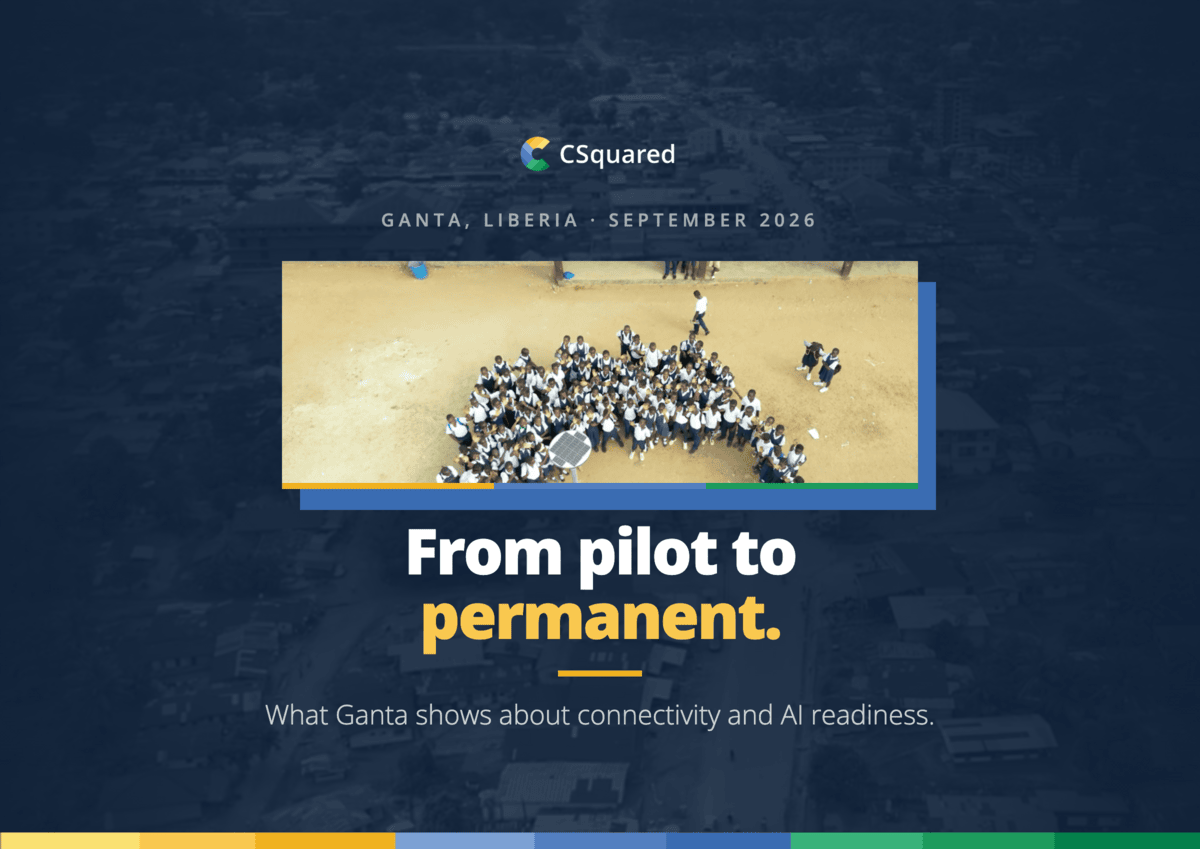
Ganta is a commercial town of around 76,000 people on Liberia’s border with Guinea. Traders there wanted mobile money, parents wanted their children online, and small businesses wanted a way to reach customers digitally. What Ganta lacked was reliable broadband and the skills to use it. CSquared has now closed that gap, and the way it did so may matter more than the connection itself.
CSquared has completed a commercial broadband and digital skills programme in Ganta, delivered with Microsoft, Liberia’s Ministry of Posts and Telecommunications, Telecel Liberia, the Kids’ Educational Engagement Project (KEEP) and local partners. The programme moved from a grant-funded pilot to a commercially operated network, testing whether affordable broadband and digital skills, built together, can support digital participation and future AI readiness without ongoing subsidy.
Two problems, one programme
Liberia is preparing for an AI-enabled future. The Liberia AI Challenge, launched under President Joseph Boakai, AI training for civil servants delivered with the UNDP, and a draft National ICT Policy for 2025 to 2030 all point the same way. But according to the Digital 2026 report by Kepios for DataReportal, only around 30 per cent of Liberians were online at the end of 2025, leaving more than four million people without internet access. Infrastructure alone does not close that gap. People need the confidence and skills to use a connection once it exists.
CSquared’s approach in Ganta addressed both sides at once: community Wi-Fi delivered over its open-access fibre network in collaboration with Telecel Liberia, and a digital learning lab built with KEEP.
What was built
Community Wi-Fi access points went live across Ganta’s busiest residential and commercial areas. The service launched free of charge to build adoption and understand usage patterns, then moved to a commercial model. During the free introductory period, 33,000 residents connected. Usage moved quickly beyond messaging and social apps into e-payment, customer communications and day-to-day trade.
On the education side, CSquared and KEEP established a 20-seat computer laboratory and learning resource centre at J.W. Pearson Public School. It was the school’s first working computer lab, and for many of the more than 1,200 students it served, their first time using a computer. KEEP spent a year on site, training teachers in computer literacy, lab management and internet use, before handing the facility fully to the school. That grounding in basic digital literacy is, in CSquared and KEEP’s view, the foundation a first-time user needs before more advanced tools, including AI applications, become useful.
The commercial test
The most transferable result may be the pricing model itself. Following the free period, the network moved to a paid service: $1 for three days at 2Mbps, or $5 for seven days at 5Mbps. CSquared is now working with local internet service providers to build affordable products aimed at households and small businesses. Ten thousand residents and households currently pay for the service, which CSquared treats as evidence that demand holds once the free trial ends. Market traders and small businesses in Ganta now depend on the network for payments and daily operations.
“A network that depends on subsidy is a pilot, not infrastructure,” said Samuel Owusu Yeboah, CSquared’s Chief Technology Officer. “Our objective was always to build a service that local communities would value enough to sustain commercially, while investing in digital skills that give communities like Ganta a realistic route toward future AI readiness.”
Ian Paterson, CSquared’s Chief Executive Officer, framed the wider point: “AI already exists. The challenge is ensuring communities can reach it and benefit from it. A town needs two connections to do that: the fibre that carries a signal, and the learning to use it. Ganta had both.”
Part of a wider footprint
Ganta sits within CSquared’s broader Liberia investment, active since 2017, which now includes more than 250 km of metropolitan fibre across Monrovia and Montserrado, more than 350 km of national backbone infrastructure to the borders of Côte d’Ivoire and Guinea, 51 connected government institutions delivered with the Government of Liberia and USAID, and live community Wi-Fi in four towns: Gbarnga, Ganta, Kakata and Sanniquellie.
Daniel Nyan Konah, Principal of J.W. Pearson Public School, described the effect on his students: “CSquared and KEEP’s programme has brought changes in the lives of our students. They are able to browse the internet and use the computer. We train the students in batches. When one batch graduates from the programme, another batch starts.”
Brenda Brewer Moore, KEEP’s Executive Director, added: “For a school that has never had a library, this upgraded space, now strengthened with reliable connectivity, is a timely and necessary investment. We’re supporting students, teachers and community members as they build stronger reading habits and digital literacy skills.”
Why it matters beyond Ganta
CSquared considers Ganta a proof of concept rather than an isolated project. The model, pairing broadband infrastructure with digital skills training and a clear path off subsidy, is one the company believes can transfer to other underserved communities across Africa, where affordable connectivity and digital capability need to develop together as AI adoption spreads.
Sources: Digital 2026: Liberia, DataReportal, compiled by Kepios, published 8 November 2025; UNDP Liberia, “UNDP AI Sprint: Liberia Takes a Giant Leap in AI for Government”; TechAfrica News on Liberia’s draft National ICT Policy 2025–2030; CSquared Liberia country page, csquared.com/Liberia; KEEP Liberia, “KEEP Teams Up With CSquared”, 15 June 2023; CSquared internal network and billing data.